
Payette Projected Versus Actual Release
A projected date is a planning point drawn from a sentence, court credit, or parole process. Actual release is the event recorded when custody ends or moves to community supervision. The dates can differ. A court order may authorize release before jail staff finish warrant checks, property processing, and paperwork. A parole grant may set a tentative date while programming and an approved release plan remain unfinished.
A pretrial detainee usually has no sentence-based release date. Bond may be posted, changed, or denied. Another warrant or detainer, which is a request by another agency to hold or notify, may also prevent departure. Use the Payette court order and jail record instead of calculating from the arrest date.
Find Payette Projected Release Dates
The IDOC Resident/Client Search does not use one generic field called Projected Release Date. Active records may show Parole Eligibility Date, Next Parole Hearing Date, and Sentence Satisfaction Date. A Tentative Parole Date comes from a Commission grant. Each label answers a different question.
- Decide whether the person has a county jail case or an IDOC sentence.
- For IDOC, search by last name or IDOC number and match the full name, birth year, middle name, and number.
- Open the detail and copy each date with its exact label. Review all sentence rows for concurrent or consecutive terms.
- Check the Commission decision when parole has been considered.
- For a county sentence, call Jail/Inmate Records at 208-642-6006 extension 1143 and read the court commitment through iCourt.
- Confirm the actual event afterward through IDOC status or the county release ledger.
The broader Payette County release search helps distinguish a community release from a transfer. A person leaving the county jail for IDOC remains in custody.
Idaho Sentence Date Rules
Idaho does not apply a general federal-style rule requiring every state prisoner to serve 85 percent. Under Idaho Code section 19-2513, the court states a minimum fixed term followed by an indeterminate term. The fixed part generally controls the first parole eligibility point after applicable credit for time already served.
Ordinary good-behavior credit does not shorten that fixed portion. IDOC's Timely Release report explains that the Unified Sentencing Act eliminated routine good-conduct reduction. Section 20-101D permits a narrow discretionary reduction for extraordinary heroism or outstanding service. It is not earned time that can be assumed in a personal calculation. Medical parole under section 20-1006 is also a distinct statutory route.
Multiple sentences require care. Consecutive fixed terms can extend the controlling minimum. Concurrent terms overlap, but the latest controlling indeterminate start may govern parole eligibility. Jail or prior-custody credit, mandatory minimums, and an amended judgment can change the result. Obtain the judgment rather than counting years from a sentencing date.
Why Payette Release Dates Change
Even a correctly copied date can change as the legal and administrative record develops. IDOC warns that status, location, and scheduled termination can move quickly, while its public search updates daily.
| Factor | Possible effect | Record to check |
|---|---|---|
| Corrected custody credit | Moves a sentence calculation | Judgment and IDOC sentence row |
| Amended judgment or appeal | Changes the controlling term | iCourt and filed order |
| Concurrent or consecutive terms | Changes the controlling eligibility point | All sentence rows |
| Parole decision | May set, deny, or continue a tentative date | Commission Notice of Action |
| Programming or release plan | Can delay a granted tentative date | IDOC and Commission |
| Detainer or warrant | May cause transfer instead of community release | Jail, court, and receiving agency |
A disciplinary or procedural development can affect parole review, but Idaho's framework should not be described as routine good-time loss. The controlling question is what the judgment, Commission, and IDOC currently record.
Confirm Payette Actual Release
For state cases, In community means the person remains under IDOC jurisdiction outside prison. Read the sentence row for Released to Supervision, which records the most recent placement on court or Commission supervision. A later Discharged [date] shows the IDOC sentence ended, not necessarily the prison gate date.
For county cases, call Jail/Inmate Records and ask for the recorded release date, time, authority, and destination. The court supplies the legal order but may not show the minute jail processing finished. If staff limit telephone disclosure, make a narrowly dated public-record request.
Idaho VINELink offers status notifications for participating records. Its alert is timely evidence, not a certified historical ledger. Save the event wording, agency, and timestamp, then confirm it.
Three Idaho Release Date Labels
Parole Eligibility Date is the earliest point at which parole may be considered, often the start of the indeterminate term. It is not a right to release. Tentative Parole Date exists only after the Commission grants parole and remains subject to programming, plan approval, and final paperwork. Sentence Satisfaction Date is the endpoint reflected in the IDOC sentence record.
| IDOC or Commission label | What it means |
|---|---|
| Parole Eligibility Date | Earliest possible parole consideration point |
| Tentative Parole Date | Conditional target after a Commission grant |
| Sentence Satisfaction Date | Full sentence endpoint in the record |
The IDOC detail source shows how date fields sit within an individual record.
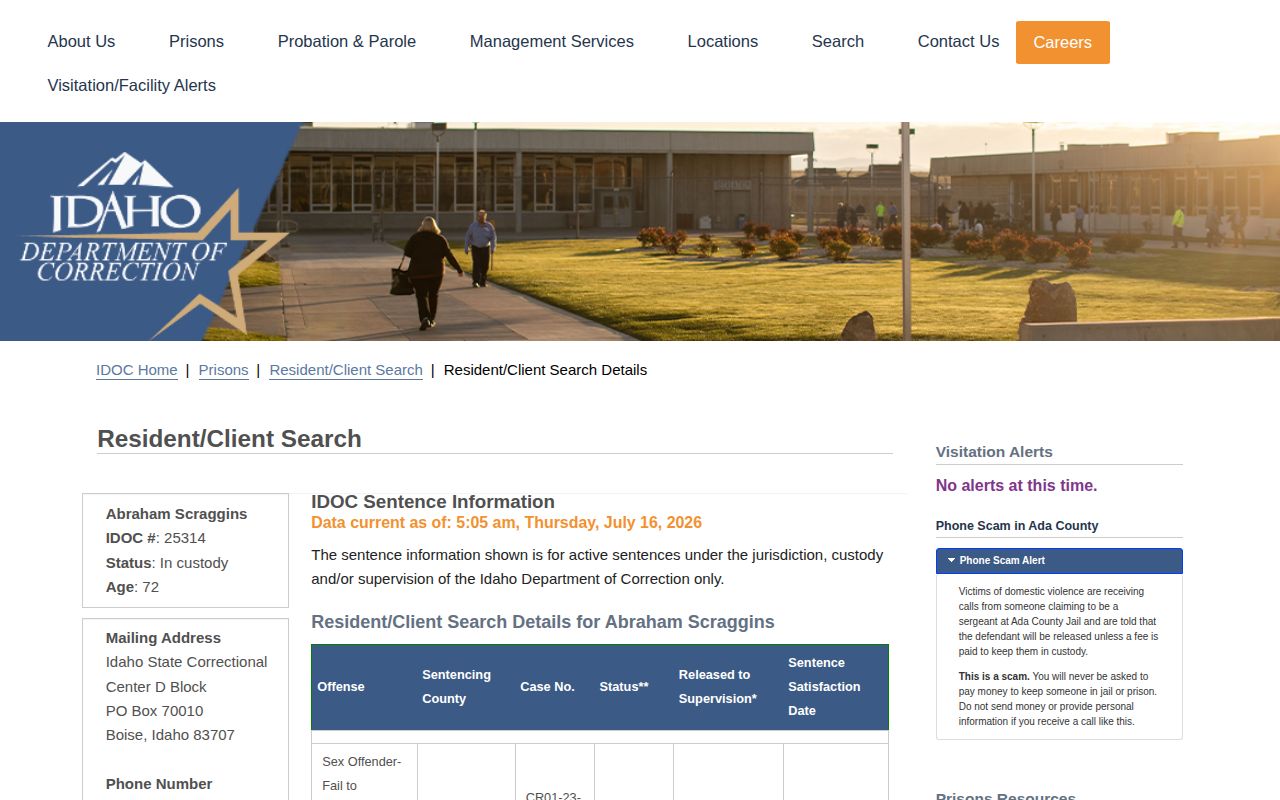
The image reinforces why the label beside a date must be preserved rather than replaced with a broad projected-release phrase.
Payette County Jail Dates
A county jail sentence does not use IDOC parole fields. Start with the commitment and jail ledger. Payette publishes no local good-time calculation policy online, so do not apply a state or federal formula. Ask Jail/Inmate Records for the rule applied and recorded date.
A pretrial detainee often has no fixed date. Bond, recognizance, dismissal, transfer, or court action can change custody. The docket shows legal authority; the jail shows when processing ended. Work release is partial custody, requires judicial privilege and a schedule, and is not sentence completion.
Do Not Calculate Payette Dates
Obtain the judgment and verify prior-custody credit. Determine whether terms run together or one after another. Then compare all IDOC rows and Commission action. The latest controlling minimum may govern eligibility when several sentences exist.
Mandatory minimums and case-specific rules may control. Research does not support a broad excluded-offense list. Public fields are clues, not a substitute for the official computation.
- Fixed term
- The minimum prison part generally served before parole eligibility.
- Indeterminate term
- The later range in which discretionary parole may occur.
- Time-served credit
- Court-recognized prior custody affecting the computation.
- Consecutive
- Terms served one after another.
Payette Commission Date Check
The hearing schedule lists date, type, IDOC number, and name. Review decisions can show the outcome, next hearing, and tentative date. A grant still depends on programming, an approved plan, and final paperwork.
After the target, “In community” plus Released to Supervision supports physical transition. A later “Discharged” date ends jurisdiction. If the detail still says “In custody,” contact IDOC instead of assuming release.
Payette Release Date Evidence
The strongest check uses the judgment, IDOC rows, Commission action, and later status. Each proves a different part. A detainer may redirect a person to another agency even when one sentence permits release.
Corrected credit, amended judgment, appeal, rare statutory reduction, programming, plan approval, or a new hold can alter the path. Record when each source was checked because IDOC warns that location and scheduled termination can change quickly.
Payette Parole Eligibility Limits
Idaho Code section 20-223 makes parole discretionary. Completion of the fixed term opens eligibility only when the judgment and other rules permit it. The Commission can deny, continue, or grant, and a grant may still carry a tentative date. Do not restate eligibility as a scheduled exit.
Section 20-101D permits a limited discretionary reduction for extraordinary heroism or outstanding service. It is not ordinary earned time. Medical parole under section 20-1006 is another narrow route. Neither supports subtracting a standard percentage from a Payette sentence.
When several terms exist, compare each fixed portion and whether the judgment makes terms concurrent or consecutive. The Commission FAQ explains that the controlling calculation may use the latest indeterminate-begin date. IDOC or counsel should resolve a contested computation.
Payette Release Destination Holds
A date may mark the end of one authority but still lead to transfer. A detainer can send a person to a county, state, federal, or immigration custodian. Ask the current facility whether the target is community release or a handoff and record the receiving agency.
For Payette jail custody, request actual time, release authority, and destination. For IDOC, review status and Released to Supervision. For federal custody, use the named federal agency. This keeps a valid sentence date from being mistaken for freedom from all custody.
The court order, jail ledger, IDOC row, and receiving-agency record may each show a different timestamp. Preserve the label beside each date. Those labels explain the sequence and prevent false conflict.
Check Payette Date Updates
Recheck the public record close to the expected event. IDOC updates daily but warns that a fast change may not yet appear. Record the data-current timestamp, status, location, and every labeled date. Then call the office shown on the detail if confirmation cannot wait.
A Commission Notice of Action can be posted after the hearing and may set a next review or tentative date. It is a decision record, not a transport log. Jail staff or IDOC confirm the actual custody movement.
Once community placement appears, the projected-date question changes to supervision status. Read the parole or probation row and Released to Supervision. Once “Discharged” appears, the displayed date marks sentence completion. These stages should not be collapsed into one generic release date.